
Title 24 Energy Compliance in Anaheim, CA
Title 24 energy compliance is a California state requirement that every new ADU – and most significant conversions – must satisfy before the building department issues a permit. For Anaheim homeowners, that means submitting a California Energy Commission (CEC)-compliant energy report alongside your ADU Design & Blueprints, documenting that your unit meets insulation, glazing, HVAC efficiency, and lighting standards. Without it, your permit application stalls at the counter.
At Ellery ADU Studio Anaheim, Title 24 calculations are produced in-house, as part of the permit set – not farmed out to a third-party consultant you have to manage yourself. Every project we take on falls under a single written contract at a single written price, per Haven Standard Clause 1. If you have a question before we start, call (657) 366-5740 – a live person answers, no voicemail. Our full approach to drawings, reports, and city submissions is covered on our ADU Design & Permitting in Anaheim page.
Anaheim sits in California’s Climate Zone 8 – a fact that shapes every energy calculation we produce for this city. Zone 8’s warm, dry summers and mild winters mean your ADU’s cooling load typically drives the compliance strategy, not the heating load. That distinction matters when we’re specifying wall insulation R-values, selecting window U-factors, and sizing mechanical equipment. A report written for a Sacramento project in Climate Zone 16 would fail here. Ours are written specifically for Zone 8, using current CEC-approved software and Anaheim’s local amendments.
When You Need Title 24 Energy Compliance
The short answer is: almost always, for any ADU in Anaheim. But here are the specific situations that trigger the requirement and tend to catch homeowners off guard.
- New detached ADU construction. Any newly built unit – whether stick-framed on site or a prefab system like Abodu placed on a prepared foundation – requires a full Title 24 energy report before the city will accept your permit application. There are no size-based exemptions for small ADUs.
- Garage conversion ADUs. Converting an attached or detached garage in neighborhoods like East Anaheim or the Colony District means the new conditioned space must meet current energy standards, even though the shell already exists. Existing wall framing, a concrete slab, and roll-up door openings all create compliance wrinkles that require careful calculation.
- Junior ADU interior conversions. A JADU carved from existing living space within the primary residence is generally lower-complexity, but it still requires documentation – particularly around lighting, mechanical ventilation, and any new glazing added for egress or natural light.
- Adding mechanical cooling to a previously unconditioned space. If the original structure had no HVAC and you’re introducing a mini-split or central system as part of the conversion, that triggers a compliance review of the entire thermal envelope, not just the equipment.
- Permit corrections and resubmittals. We regularly see Anaheim homeowners who hired a designer and a separate contractor, then received a city correction citing a missing or non-compliant energy report. If you’re in that situation, our Free Second Opinion applies – bring the written correction letter and we’ll tell you exactly what’s missing and what it will cost to fix it.
- Prefab and modular placements. Factory-built units from brands like Plant Prefab arrive with their own manufacturer’s energy documentation, but that documentation still has to be reconciled with California’s current Part 6 standards and Anaheim’s local requirements before the city accepts the package. We coordinate that reconciliation as part of our permit set production.
Our Title 24 Energy Compliance Process
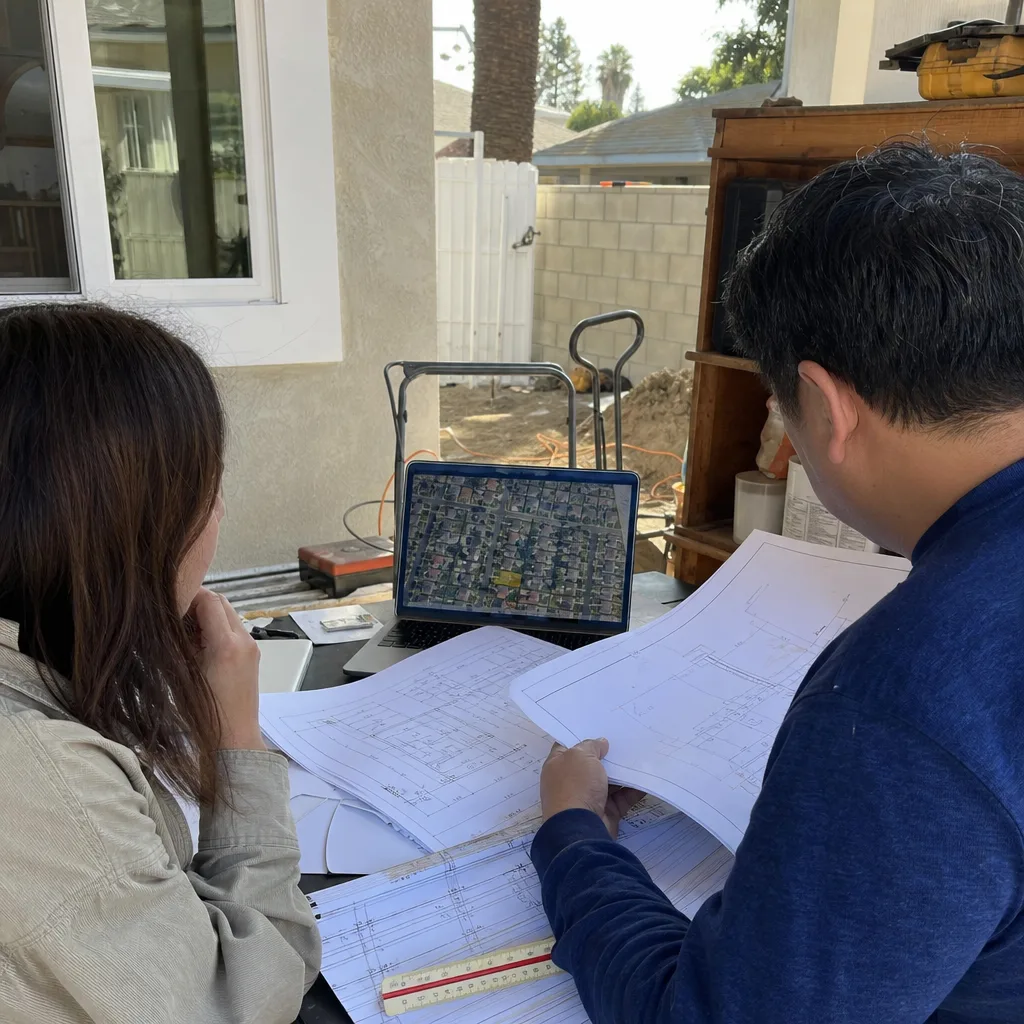
Every energy report we produce follows the same documented sequence – no steps skipped, no reports issued before the design is locked. Here is what the process looks like from your perspective.
- Site and design data collection. Before we open the energy modeling software, we need accurate information: your lot’s orientation (south-facing glass in Anaheim’s Zone 8 behaves very differently from north-facing), the wall assembly your project calls for, roof pitch and insulation access, window-to-floor-area ratios, and the mechanical system you’re planning. If you’re early in the design phase, this step runs in parallel with the architectural drawings – we don’t make you wait for a finished set to begin the energy work.
- Prescriptive vs. performance path determination. California Title 24 Part 6 allows two compliance pathways. The prescriptive path applies fixed minimum standards – specific R-values, U-factors, SHGC limits – and is faster to document. The performance path runs a full energy simulation and can trade off stricter insulation for better windows, or vice versa. For most Anaheim ADUs under 800 square feet, we evaluate both and use whichever produces the most cost-effective construction spec for your project. We explain the trade-off in plain language before we commit to a path.
- Energy modeling and CF1R production. We run the calculations using CEC-approved software and produce the CF1R-ALT-E or CF1R-ADD-E form – the official compliance document the City of Anaheim Building Division requires. This form identifies your mandatory measures: insulation levels, fenestration specs, HVAC equipment efficiency ratings, water heating, and any solar-ready conduit requirements triggered by the project type.
- Integration into the permit drawing set. The energy report doesn’t go into a separate envelope – it’s incorporated into the permit set as a coordinated document. The drawings reference the CF1R; the CF1R references the drawings. When Anaheim plan check reviews your application, both documents tell the same story. This is where the single-contract design-build model eliminates the common gap: there is no separate engineer or energy consultant who produced a report the architect never reviewed.
- Plan check response, if needed. Anaheim Building Division occasionally issues energy-related corrections – typically around HVAC equipment documentation or solar-ready conduit details. Because the energy report is our document, not a subcontractor’s, we respond directly and quickly. You don’t chase a third party for a correction letter revision.
- Field verification and CF2R/CF3R documentation. Title 24 compliance doesn’t end at permit issuance. The HERS (Home Energy Rating System) field verification stage – documented on the CF2R and CF3R forms – must be completed before the city issues final sign-off. We coordinate the HERS rater’s site visit and make sure the completed forms reach the building department. The 365-Day Done Right Promise means that if the field verification reveals an installation that doesn’t match the permitted drawings, we correct it, in writing, before you sign off.
Title 24 Energy Compliance Pricing in Anaheim
Title 24 energy compliance for an Anaheim ADU is not priced as a standalone line item at Ellery ADU Studio – it’s included in the permit set fee, which is part of your single written contract price. That said, here is what the energy compliance work component typically represents within the overall permit set cost, so you can evaluate any third-party quotes accurately.
| Project Type | Typical Energy Compliance Component | Notes |
|---|---|---|
| JADU / Interior Conversion | $400 – $700 | Lower complexity; existing thermal envelope largely unchanged |
| Garage Conversion ADU | $600 – $1,100 | New conditioned space; wall, ceiling, and glazing compliance required |
| New Detached ADU (site-built) | $800 – $1,400 | Full performance or prescriptive path; solar-ready conduit review |
| Prefab / Modular Coordination (e.g., Abodu, Plant Prefab) | $500 – $900 | Manufacturer’s documentation reconciled with current CEC standards and Anaheim local amendments |
| Plan Check Correction Response | $250 – $600 | Applies when correcting a report produced by another firm |
What affects cost within these ranges: project square footage, the mechanical system selected, whether the performance path is needed to unlock a construction savings elsewhere in the spec, and how much coordination is required with a prefab manufacturer’s existing documentation package.
Per Haven Standard Clause 1, every Ellery project receives a written price before any work starts in Anaheim, CA. You will see a line item for the permit set – which includes the energy compliance work – before you sign anything. There are no post-contract additions for plan check responses on energy corrections; those are covered. To get your written project price, call (657) 366-5740. If you have a written estimate from another firm and want a second opinion, bring it – that review is free.
FAQs – Title 24 Energy Compliance
Does my Anaheim ADU actually need Title 24 compliance, or is it optional?
It is required, not optional. California’s Title 24, Part 6 applies to all new residential construction and to alterations that add conditioned space – which covers every ADU type permitted in Anaheim. The City of Anaheim Building Division will not accept an ADU permit application without a compliant energy report. There is no size threshold below which the requirement disappears; even a 200-square-foot JADU conversion requires documentation of lighting and ventilation compliance. If someone told you it’s optional for a small unit, get that in writing – and then call us at (657) 366-5740 for a second opinion before you submit.
How long does the Title 24 report take to produce?
For a typical Anaheim ADU, the energy report is produced concurrently with the architectural drawings – it does not add time to your permit set delivery. The modeling itself takes two to five business days once the design is locked and we have confirmed mechanical system specifications. The document that slows projects down is usually the HERS field verification at the end of construction, not the initial report. We schedule the HERS rater’s visit as part of our project closeout sequence, so that step doesn’t catch you waiting after your contractor finishes.
What is the difference between the CF1R, CF2R, and CF3R?
The CF1R is the compliance certificate produced by the energy consultant (us) at the design stage – it’s what goes into your permit application and tells the city what measures your ADU is designed to meet. The CF2R is the field verification form completed by a HERS rater during construction, confirming that what was designed was actually installed – correct duct sealing, verified insulation depth, confirmed HVAC equipment model numbers. The CF3R is the homeowner’s certificate of installation, signed by the contractor, that documents the specific products installed. All three are required before the city will issue final inspection approval. Under our single-contract model, Ellery coordinates all three documents – you don’t manage separate parties for each.
Can I use the same Title 24 report if I change the HVAC system during construction?
Not without a revision. The CF1R is tied to specific equipment – efficiency ratings, fuel type, distribution system type. If you switch from a ducted system to a ductless mini-split, or change from one equipment model to another with a different SEER2 or HSPF2 rating, the report has to be updated and the revised CF1R submitted to the building department before the HERS rater visits. We handle those mid-project revisions internally for projects under our contract. If you made a change without updating the report and your final inspection is now at risk, call (657) 366-5740 – correction work is something we can quote in writing same day.
What Anaheim-Specific Factors Shape Your Energy Report
Climate Zone 8 is not a trivial distinction. Anaheim’s combination of summer heat, low humidity, and minimal winter cold means the prescriptive path’s default assumptions can over-specify heating insulation and under-address cooling loads. In areas like West Anaheim near the 5 freeway corridor, urban heat island effects push afternoon temperatures several degrees above the CEC’s base assumptions for Zone 8 – which can affect the performance-path simulation inputs we use for equipment sizing documentation.
Anaheim also sits within the Southern California Gas territory, and many ADU projects here choose all-electric configurations – particularly when pairing a new unit with an existing rooftop solar installation. The 2022 Title 24 updates introduced new documentation requirements for all-electric new construction, including a heat pump water heater verification step that doesn’t appear in older report templates. If a consultant produces your report using a prior-cycle template, it may pass their software validation but fail Anaheim plan check.
The City of Anaheim Building Division processes ADU applications through its standard plan check queue, which currently runs two to four weeks for over-the-counter projects and four to eight weeks for full plan check review, depending on project complexity and current volume. An energy report correction, if the city flags one, adds a resubmittal cycle to that timeline. Producing the report accurately the first time is not a premium service – it’s the baseline we hold ourselves to on every permit set we submit.
For projects using James Hardie fiber cement siding – a common specification on Anaheim garage conversions and new detached ADUs because of its dimensional stability in Southern California’s climate – the wall assembly thermal resistance values must be calculated correctly in the energy model. Fiber cement’s thermal properties differ from wood lap siding, and the framing factor calculation changes depending on whether the project uses 2×4 or 2×6 exterior framing. We use the correct assembly in every report we produce for Anaheim projects.
How This Fits Into Your Full ADU Project
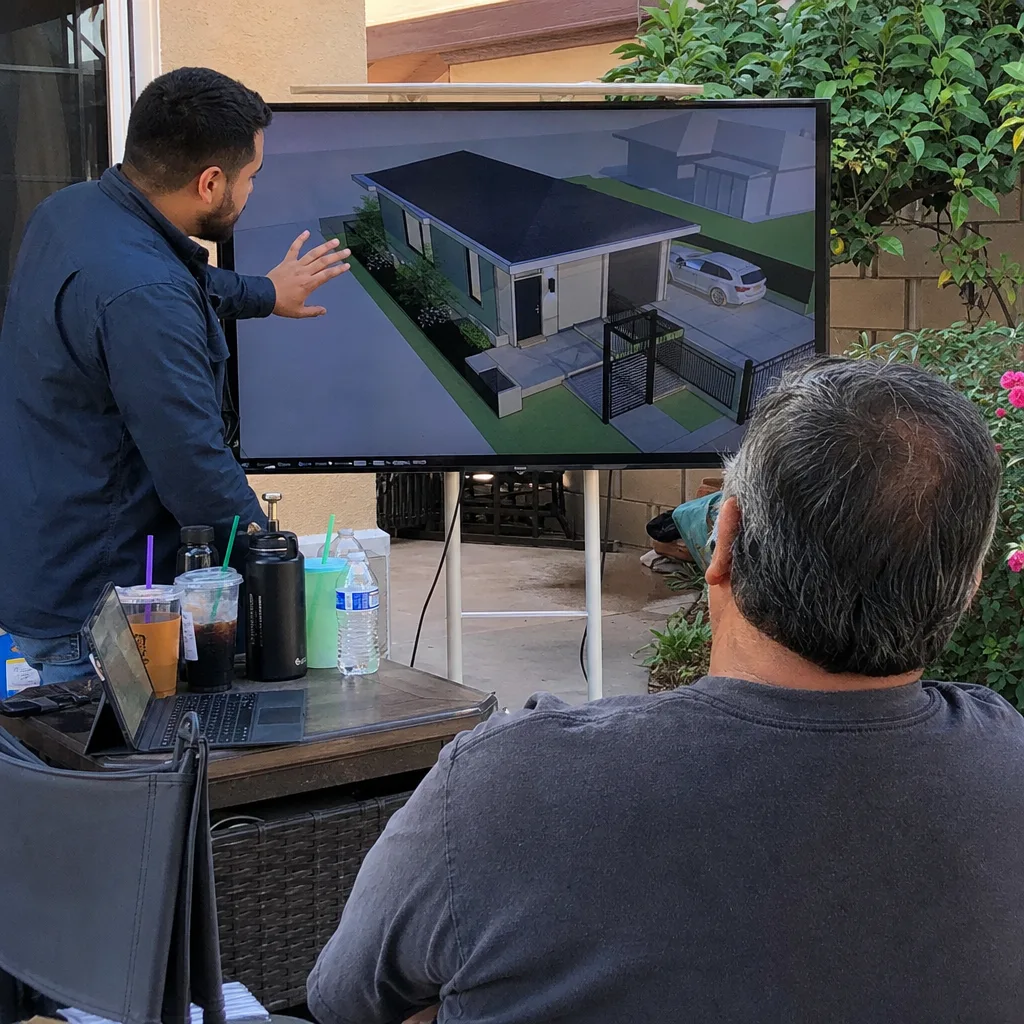
Title 24 energy compliance is one document within a permit set that typically includes architectural floor plans, site plan, foundation plan, structural details, electrical plan, plumbing plan, and the energy report. At Ellery ADU Studio, all of those documents are produced under our ADU Design & Permitting services as a coordinated package. There is no scenario where the energy consultant’s assumptions conflict with the architect’s window schedule because the two documents were produced in the same office, by the same team, reviewing each other.
If you’re at the beginning of planning and want to understand the full scope of what an ADU permit set involves – not just the energy piece – our ADU Design & Permitting in Anaheim page covers the complete picture: what documents the city requires, how our single-contract model works, and what the written price includes. You can also read more about our studio’s overall approach on our home page.
Since 2015, Ellery ADU Studio has produced permit sets for more than 900 ADUs across Southern California, every one with a written price before work started. The energy compliance piece has never been optional, never been an afterthought, and never been handed to a consultant we don’t supervise. That consistency is what the 365-Day Done Right Promise is built on.
Key Takeaways
- Title 24 energy compliance is required for every ADU permit in Anaheim – no size exemptions.
- Anaheim is in Climate Zone 8; reports must reflect Zone 8 cooling loads and current 2022-cycle CEC standards, not prior templates.
- Energy compliance work at Ellery includes CF1R production, plan check response, and HERS field verification coordination – all under one contract.
- The compliance component of the permit set typically runs $400-$1,400 depending on project type, and is included in your single written project price before work starts.
- A Free Second Opinion is available if you have a written estimate or a city correction letter from another firm.
- Call (657) 366-5740 to get your written project price – a live person answers, any hour.
Ready to get your Anaheim ADU’s energy compliance handled correctly, the first time, as part of a complete permit set? Call Ellery ADU Studio Anaheim at (657) 366-5740. A live person will pick up. We’ll confirm whether your project falls under the prescriptive or performance path, give you a written price that covers the full permit set including Title 24 compliance, and tell you exactly what documentation you’ll receive – before you commit to anything.
Written by Nadia Ellery, Owner at Ellery ADU Studio Anaheim, serving Anaheim.